
Articles
- Details
- Written by: Administrator
- Category: Articles
- Hits: 18
Without sufficient warning in early 1888, a great snowstorm impudently attacked the plains states, and a different blizzard later paralyzed the East. The "School Children's Blizzard," remembered as the most famous in Great Plains history, stretched broadly from the rugged Rockies eastward to the mighty Mississippi River, and swept from Canada, ay, all the way down to the great state of Texas.
On her way home from elementary school classes on Thursday afternoon, January 12, at Table Rock, Neb., 11-year-old Avis Dopp was caught in the fury of the violent winter assault. A blinding barrage of snowflakes was driven by strong winds which wrapped schoolgirls' skirts around their legs, frightfully impairing efforts of the youngsters to reach safety. Battling the powerful force of the stiff cold air currents, and stumbling through the reduced visibility of the fierce snowy gale, young Avis "was down more than up," and her hands froze painfully during the lengthy one-block trip to her house. Flora Dopp, a former nurse, revived her suffering daughter's agonized hands in cold water, while the girl believed her fingernails were starting to come off.
The unresolved fate of absent loved ones tormented other worried residents who themselves had successfully found refuge during the widespread turmoil. At the Dopp house, the anxious females feared for Avis' father, a teacher who daily commuted on horseback to his school west of Pawnee City. Avis recalled the tremendous storm lasted from 2:00 p. m. till 6:00 p. m., leaving drifted snowbanks and frigid temperatures which made conventional travel very hazardous.
The winter sky cleared just before dusk, Avis later remembered, after three or four feet of snow had fallen and the strong winds had caused drifting. In the aftermath of the massive blizzard, Seymour H. Dopp kept his 17 pupils protected overnight in the country schoolhouse, where they had stockpiled fuel for a warm fire, and sheltered his faithful riding horse in the chilly enclosure of an unheated cob shed.
The next morning, on Friday the 13th, concerned parents of the stranded students guided horse teams over snow-covered country roads as they negotiated farm wagons through the deep drifts all the way to Seymour Dopp's schoolhouse. And once there, the relieved adults happily rescued their weary and hungry children. Astride his reliable steed, schoolmaster Dopp then successfully navigated through all the white stuff back to his own family awaiting in snowbound Table Rock.
Modern chroniclers, ignoring the U. S. heartland, seem to prefer to refer to a blizzard in New York and Pennsylvania only as the "Blizzard of 1888." But that snowstorm was significantly smaller when compared to 1888's earlier blast striking right down the country's mid-section. A more precise contemporary description from the Encyclopedia Britannica of 1893, only five years after the event, provides no mention at all of the East:
"In one (blizzard) which visited Dakota and the States of Montana, Minnesota, Nebraska, Kansas and Texas in January, 1888, the mercury fell within twenty-four hours from 74º above zero to 28º below it in some places, and in Dakota went down to 40º below zero. In fine clear weather, with little or no warning, the sky darkened and the air was filled with snow, or ice-dust, as fine as flour, driven before a wind so furious and roaring that men's voices were inaudible at a distance of six feet. Men in the fields and children on their way from school died ere they could reach shelter; some of them having been not frozen, but suffocated from the impossibility of breathing the blizzard. Some 235 persons lost their lives. This was the worst storm since 1864; the Colorado River in Texas was frozen with ice a foot thick, for the first time in the memory of man."
- Details
- Written by: Administrator
- Category: Articles
- Hits: 22
Kansas has been blessed with a number of innovative inventors, entrepreneurs, and problem-solvers. For example, Kansas has been home to
- William Purvis and Charlie Wilson: first patented the helicopter in 1909
- Almon Stauger: first working model of the dial telephone in 1889
- David D. Blanton: invented the autopilot in 1954
- Jack Kilby: created the microchip in 1958
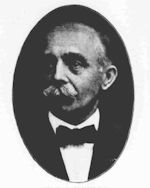
But one of the most impressive members of this group must be Samuel Jay Crumbine, an extraordinary problem-solver in the area of public health. His accomplishments in the last century still impact us today.
Dr. Crumbine was born in Emleton, Pennsylvania, in 1862 but emigrated to Dodge City, Kansas, when he graduated from medical school in 1888. Dr. Crumbine began his medical career in this rough frontier town, joining residents in other professions such as Wyatt Earp, Bat Masterson, and Bill Tilghman. Dr. Crumbine became known as "the frontier doctor." Some even claimed he was the model for the character Doc Adams in the "Gunsmoke" TV series!
In 1899, Kansas Governor W. E. Stanley appointed Dr. Crumbine to the Kansas State Board of Health. From 1911 to 1915, the Frontier Doctor served as dean of the University of Kansas Medical College. Then, in 1914, he became the Secretary and Executive Officer of the Kansas State Board of Health. All during this time, Dr. Crumbine dedicated himself to solving public health problems.
His concern about flies spreading typhus led him to popularize Frank Rose's invention of the fly-swatter, encouraging people to use this tool to "Swat the Fly!" Another effective campaign to limit infections was Dr. Crumbine's "Don't Spit on the Sidewalk!" He even persuaded brick manufacturers to create sidewalk paving bricks embossed with "Don't Spit on the Sidewalk."
Dr. Crumbine was also very concerned about the spread of tuberculosis. He banned the common drinking cup and urged people to use the disposable paper drinking cups that he'd heard about from Hugh Moore. Initially called "health cups," the paper containers became known nation-wide as Dixie Cups. The reusable rolling towel often found in restrooms was also a barrier to limiting tuberculosis. So Dr. Crumbine encouraged people to use easily discarded paper towels instead.
Another public health concern was the health and safety of babies and their mothers. Dr. Crumbine started a "Save the Baby!" campaign. The goals of the campaign were to provide safe milk, visiting nurses, and child protective services. The Division of Child Welfare that he created was an idea that spread across the nation.
Dr. Crumbine called for improvements in sewage and wastewater plants. As a result, by 1914, Kansas ranked fourth in the country among the number of towns with sewage treatment plants.
He also established the first postgraduate course in the United States for county health officials. He fought against misleading and false food and drug labels. And Dr. Crumbine was even able to require hotels to change the sheets on their beds on a regular basis.
In all these ways and more, a Kansas frontier doctor was able to make changes that improved public health across the nation and, it could be argued, across the globe. Dr. Samuel Jay Crumbine's relentless problem-solving made life better, and safer, for all of us.